From documents to usable evidence
Prevention of Future Deaths reports contain detailed accounts of risks, failures, and actions that could prevent similar deaths. More than 6,000 reports have been published in England and Wales since 2013, but their evidence is locked inside inconsistent, unstructured documents. PFD Toolkit makes that evidence searchable, structured, and ready for analysis.
One product, two ways to work
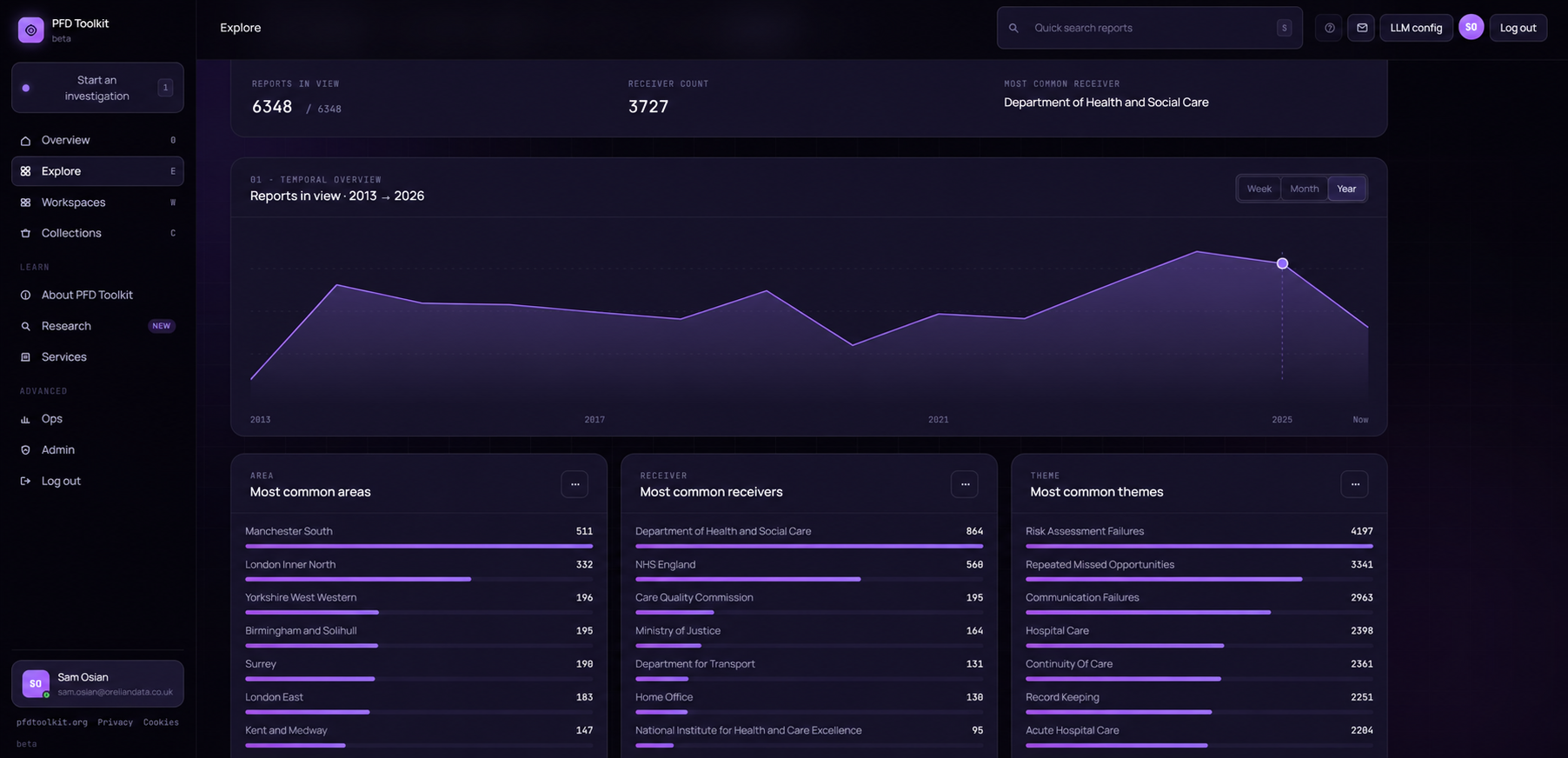
PFD Toolkit is available as a web application for researchers who want to explore reports without setting up code, and as a Python package for reproducible analysis. Users can load reports, screen cases against specific criteria, discover themes, and export categorised datasets through a consistent workflow.
Automated from end to end
The platform retrieves reports from the judiciary website, uses optical character recognition for scanned documents, and applies language models to extract structured fields. These include demographics, death settings, coroner areas, report categories, specific concerns, and recommended actions. A process that previously required months of manual review can run across thousands of reports in minutes.
Evidence you can inspect
Every extracted result links back to the source report and the relevant supporting text. Researchers can inspect why a record was classified in a particular way instead of treating the model as a black box. In validation against independent clinical review, the extraction system achieved 97% agreement with clinical judgement.
Analysis beyond search
The interactive toolkit supports thematic screening, structured exports, trend analysis, and network exploration across locations, agencies, and recurring concerns. In a replication of an Office for National Statistics study on child suicide reports, the automated pipeline identified 72 relevant reports compared with 37 found in the original manual process.
Built as reusable infrastructure
PFD Toolkit provides a maintained product layer over a repeatable document-processing pipeline. Its architecture offers a foundation for other evidence-heavy domains where records are public but difficult to use, including healthcare, legal, and regulatory data.